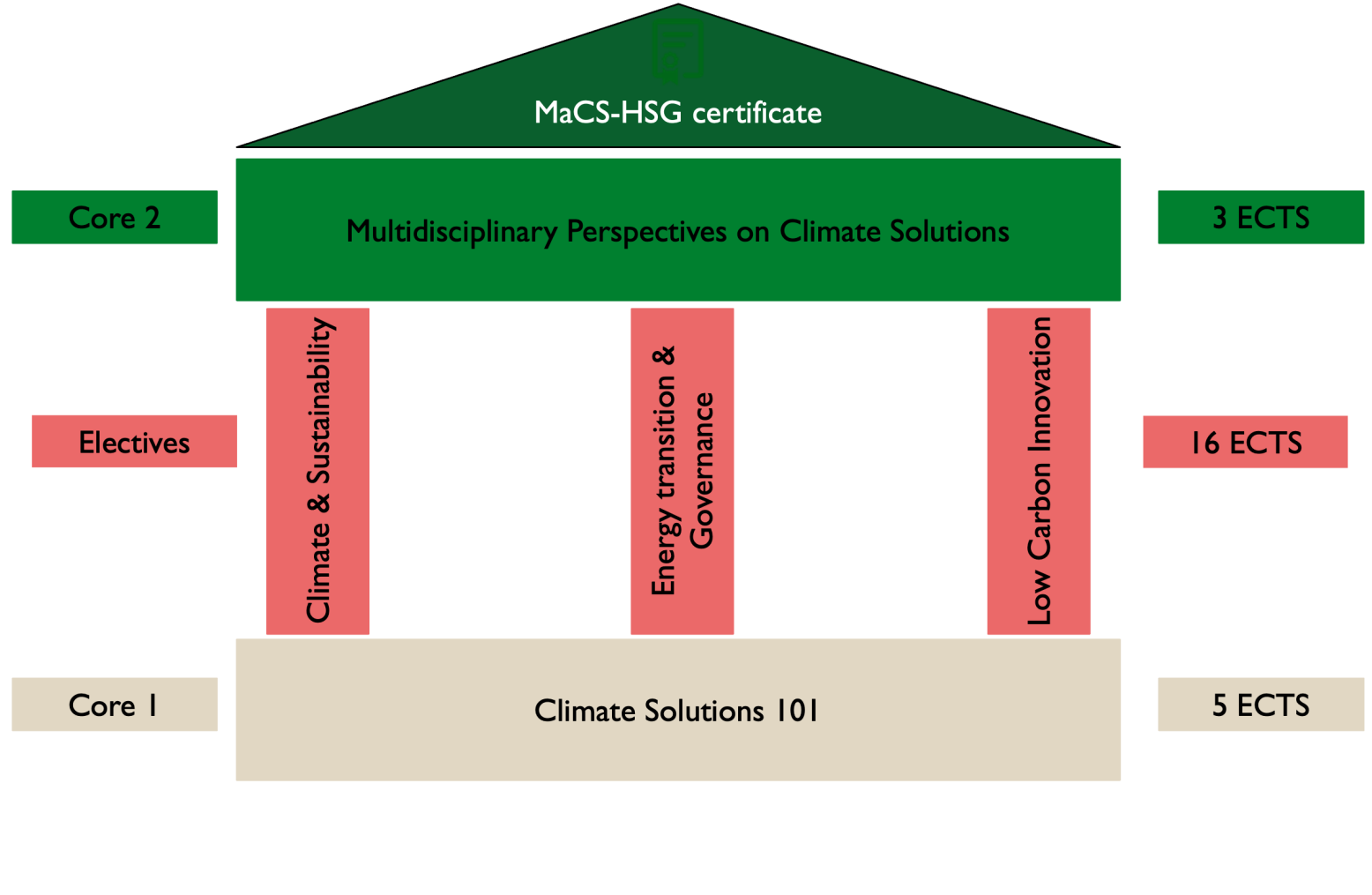
The programme consists of:
(a) An introductory course “Climate Solutions 101” in the fall semester, combining a physical kick-off with blended learning elements and a compact course in the second week of the semester break,
(b) A set of elective courses from various Master programmes at the University of St.Gallen, and
(c) A mandatory course “Multidisciplinary Perspectives on Climate Solutions” in the spring semester, where the students will implement a specific climate solution. The design of the programme allows electives to be partially recognized for the student’s main Master degree.

Our solar crowdfunding project aimed to progressively shift the power supply of HSG towards renewable and green energy. Over the last 10 years, HSG has already significantly reduced its electricity consumption per student. However, there was still ample room and potential for further progress. The overarching goal of the project was to secure funding for a photovoltaic system on the roof of the university's sports hall. In this context, the team aimed to use a structured and comprehensive marketing concept, primarily targeting local investors, not only to raise as much money as possible for the project but also to raise awareness of the urgency of climate change and the potential of renewable energy as a solution. Individuals got the opportunity to become an investor themselves and receive not only a solid financial return but also make a direct contribution to the future of our planet.
Learn more about the HSG Solar Crowdfunding project: http://www.macsprojectsunisg.ch/solar-crowdfunding.html
The MaCS Team behind HSG Solar Crowdfunding
Jonathan Meyer, Ines Morales Wyden, Simona Weber, Nadja Koster, Weiqi Liu
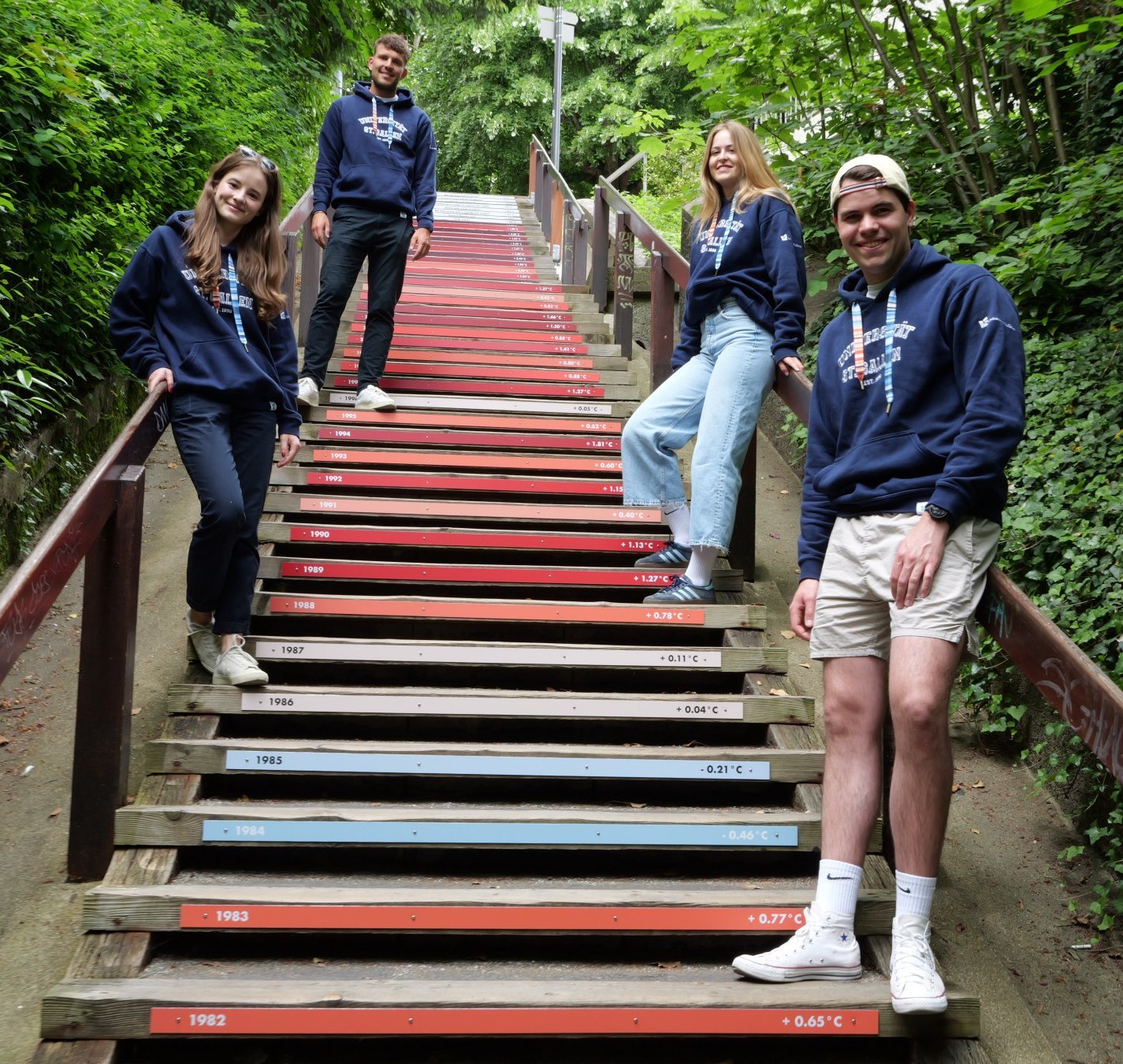
St. Gallen, the city of stairs. Many students at the University of St. Gallen face the daily challenge of climbing the stairs of Dohlengässlein. With each step, body temperature rises, and by the last step, heads glow in a reddish hue. Similarly, the climate warms year by year, in Switzerland even twice as fast as globally. That's why the team wanted to clad the staircase steps in the colors of the Climate Stripes, drawing attention to the problematic effects of climate warming for the local population and students.
Learn more about the Climate Stairs project: https://www.klimatreppe.ch/en/climate-stripes/
The MaCS Team behind Climate Stairs:
Noémie Schaub, Massimo Wenk, Anna-Lena Heinzen, Mikal Orgland
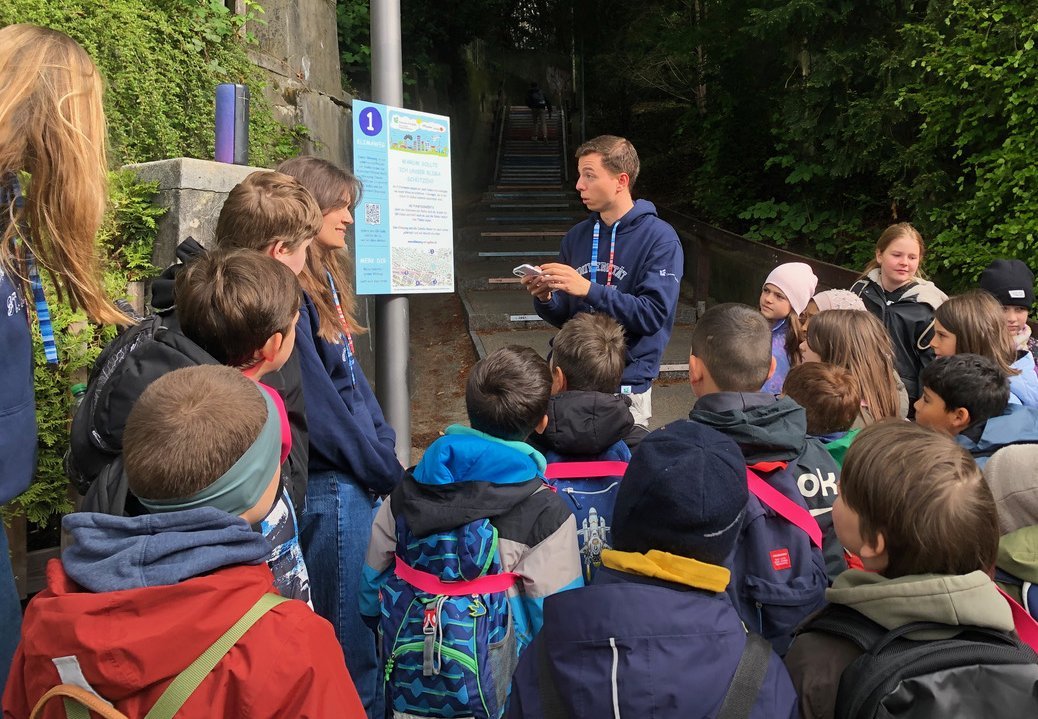
Together with a third-grade class from Engelwies School, the team created an interactive Climate Solutions Trail for the city of St. Gallen. They believe that children deserve a voice in the climate conversation — they are the future, after all! During an exciting hands-on day at the SQUARE, the children explored local and practical solutions related to climate awareness, mobility, sustainable diets, energy efficiency, and circular consumption. Their creativity, curiosity, and enthusiasm shaped this one-of-a-kind experience. Curious to see how children perceive and explain complex sustainability topics? Visit the trail and discover climate solutions through their eyes!
Learn more about the Klimaweg St.Gallen project: Klimaweg St. Gallen – Erlebe den Wandel des Klimas über die Zeit
The MaCS Team behind Klimaweg St.Gallen:
Fernando Civantos, Angela Jelusic, Géraldine Kempf, Elischa Link, Lisa Prader
Climate Solutions 101 is a specifically designed course for MaCS students and the first get-together of the cohort. The course provides the students with a basic scientific understanding of climate change and its consequences and presents potential climate solutions. The focal topics are climate science, economics & policy and implications for business.
The course will start with a physical kick-off, followed by online learning modules and quizzes. In the second week of the break, a block seminar combining guest lectures, team work and excursions will take place. Professors and climate specialists will present different perspectives on the relevant topics. Students will apply their newly acquired knowledge and get first-hand experience of managing climate solutions. At the end of the course, students submit a reflection paper to fulfill the course requirements.
Lecture
The second compulsory course “Multidisciplinary Perspectives on Climate Solutions”, will take place in the spring semester. Service learning will be used as a teaching method with the aim to implement a project on campus or in the region that has a positive effect on the climate.
The course will be held during the regular semester dates, covering the full length of the semester. The course includes 6 half-day lectures and project work in between these dates.
A set of elective courses can be selected from the three core areas (1) Climate and Sustainability, (2) Energy Transition & Governance, and (3) Low Carbon Innovation.
The preliminary menu of elective courses can be found here.